
City or Countryside: The Question That Defines Your Entire Working Holiday
City or regional Australia? This one decision shapes your income, friendships, and entire working holiday. Here's how to choose — and what most guides won't tell you.
City or Countryside: The Question That Defines Your Entire Working Holiday
The most consequential decision you'll make on your working holiday isn't which visa to apply for, or which flight to book, or even when to go.
It's where in Australia you actually end up — and whether you chose it deliberately or just drifted into it because the hostel at the airport pointed you toward Sydney.
The city-versus-countryside question shapes your savings rate, your social circle, your daily experience, and who you become in Australia. And most people make the decision without realizing it's a decision at all.
This article puts the choice in front of you clearly, with the numbers and the honest trade-offs, so you can make it on purpose.
Two Different Australias
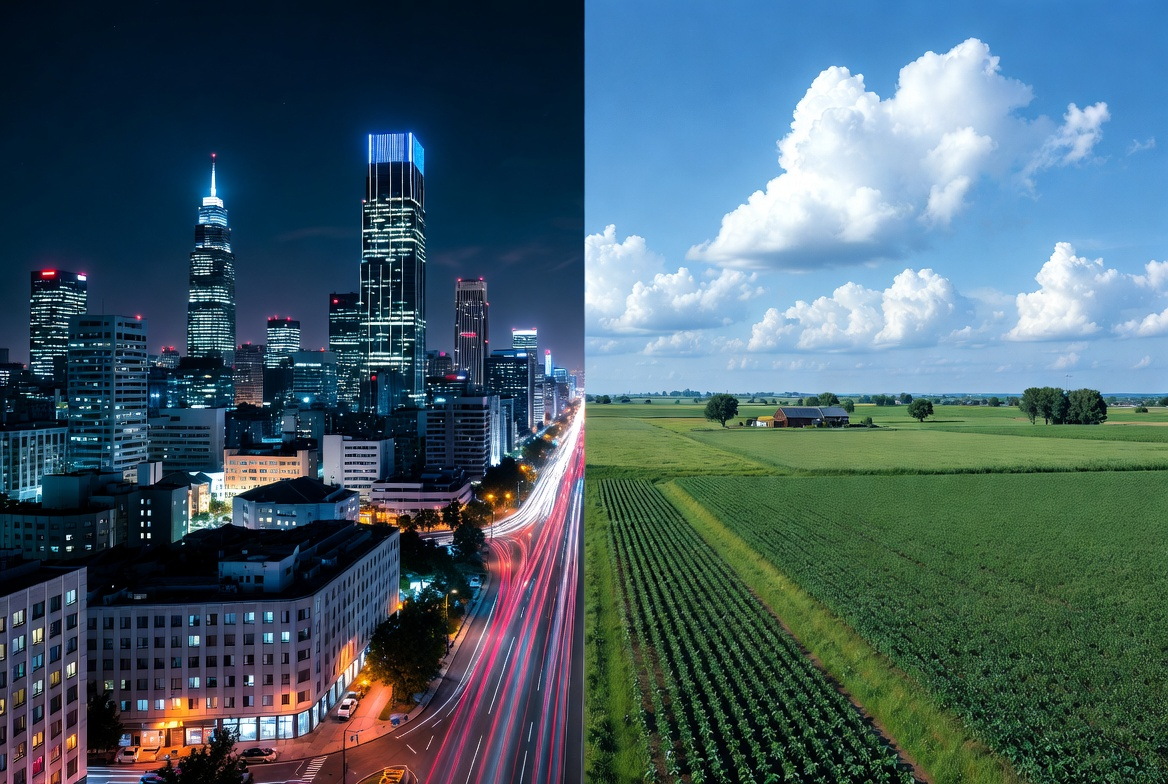
The first thing to understand is that "Australia" contains two genuinely distinct worlds, and most visitors only ever see one of them.
There is the urban Australia — Sydney, Melbourne, Brisbane, Perth, Adelaide, and to a lesser extent, Canberra. These are modern, cosmopolitan cities with functioning public transport, diverse food cultures, active nightlife, international business, universities, beaches (for the coastal ones), and all the amenities you'd expect of a wealthy, developed country. They are also expensive, competitive, crowded by Australian standards, and densely populated with other backpackers who had the same idea you did.
And then there is regional Australia — everything that isn't the major cities. Farming towns with populations in the hundreds. Coastal communities that haven't been discovered by mass tourism yet. Mining regions in the red-dust interior. Agricultural plains in Queensland, New South Wales, Victoria, and South Australia where the horizon stretches so far that you start to understand why Australians have a different relationship with space than most people from densely populated countries.
These two Australias offer fundamentally different experiences. The working holiday that someone has in Bondi Beach backpacker hostels bears almost no resemblance to the working holiday that someone has in a cotton gin warehouse in central Queensland, 600 kilometers from the nearest major airport.
Both are real. Both are valid. But they are not the same thing, and the choice between them — or the sequence of them — is one of the most important decisions you'll make.
The Case for Starting in the City
Let's be honest about why most people head to the cities first, and why that's not entirely wrong.
The cities offer what they offer: infrastructure for someone who is brand new to a country. Banking, SIM cards, grocery stores open until late, an app-based world that functions more or less how it functions at home. For someone who has just stepped off a 10-hour flight, landed in a foreign country, and is experiencing the specific disorientation of arriving somewhere both English-speaking and fundamentally foreign — the city is a reasonable decompression chamber.
The cities also offer social density. Working holiday communities exist in concentrated form in places like Sydney's Inner West, Melbourne's CBD fringes, and Brisbane's Fortitude Valley. International backpacker communities in these areas are established, active, and genuinely welcoming. For someone arriving alone, nervous, and not knowing a single person in the country, this social infrastructure matters.
The cities have abundant hostel options at a range of prices. They have Gumtree job listings for work that doesn't require specialized skills or your own vehicle — warehouse work, café work, bar work, event staff, retail, and an enormous range of service industry jobs. It is entirely possible to arrive in Sydney, get a job in a restaurant or bar within a week, and build a reasonable life within the framework of normal city living.
The honest assessment: if your primary goal with your working holiday is cultural immersion in a cosmopolitan sense — experiencing Australian café culture, weekend markets, live music, day trips to nearby beaches and national parks, and building an international social circle — the city delivers this efficiently.
And if your English is at an early stage and you want time to build confidence and get oriented before the more demanding challenges of regional work, the city is a legitimate staging ground.
What the City Doesn't Tell You
The thing about city-based backpackers is that many of them don't know what they're missing, because they never go anywhere to find out.
The wages in city hospitality and retail hover around the legal minimum — AUD $24.95 per hour (2025–2026 financial year) for permanent employees, with casual loading for most backpackers. After rent — conservatively AUD $250–350 per week for a hostel dorm or AUD $250–400 for a room in a shared house — food, transport, and the unavoidable social spending that city life generates, many city-based backpackers end their year with less savings than they'd hoped and the nagging sense that they worked hard but somehow can't account for where it went.
This is not a criticism. It's math. The cost-of-living to wage ratio in Australian cities is not favorable for people trying to save substantial amounts. The same working hours that in a regional industrial setting would generate AUD $2,000+ per week generate perhaps AUD $700–900 in city hospitality, against higher costs.
The city also offers something else that often goes unexamined: a comfortable insulation from the actual Australia. The backpacker neighborhoods of Sydney and Melbourne are populated primarily by people from Taiwan, Korea, the UK, Ireland, France, and Germany — the same nationalities who tend to dominate the WHV program. The social world can begin to feel like an international bubble: genuinely fun, genuinely diverse in passport-stamp terms, but not particularly Australian. You can spend six months in Sydney and genuinely not know many Australians.
This isn't wrong. But it's limiting if your reason for coming was to encounter something different.
The Case for Going Regional (Sooner Than You Think)
When people who've done the WHV version where they went regional early compare notes with people who spent most of their time in the cities, the conversation almost always goes a particular way.
The regional people talk about the money. They talk about how the first month was isolating and uncomfortable but the second month was something else entirely. They talk about Australians they worked alongside who became genuine friends — not the particular kind of international friendship that fades when everyone scatters back to their home countries, but the kind that gets maintained because you actually went through something together. They talk about driving four hours through country that looked like a different planet. They talk about the sky.
The city people talk about the fun, and they mean it. But there's often a quiet concession underneath it: that they could have done better financially, that they didn't quite encounter Australia the way they'd imagined when they were planning the trip, that the year slipped by in a way that was enjoyable but less distinct than they'd expected.
What "Regional" Actually Looks Like
Regional Australia is not a monolith any more than "the city" is a monolith. The experience differs significantly based on what work you're doing, where exactly you're based, and what season you're there.
Agricultural seasonal work — fruit picking, farm harvesting — is the traditional entry point. Towns like Bundaberg (Queensland), Griffith (New South Wales), Mildura (Victoria), and Robinvale are known as working holiday hubs for farm labor. The pros: relatively accessible (no specialized skills required), cash generated quickly, generally established backpacker communities in these towns, and eligibility for the regional work requirement toward your second visa. The cons: physically demanding, piece-rate income is variable and weather-dependent, some areas have a long-standing reputation for exploitation of workers who don't know their rights.
Regional industrial and processing work — the factory farms, food processing plants, cotton gins, grain facilities — is a step up in wages and stability but typically requires either some prior experience, referrals, or specific skills (like a forklift license). These are the longer-season roles: a cotton warehouse operation running May through November provides seven months of consistent high-wage work in a single location. For the right person with the right preparation, this is the sweet spot.
Regional healthcare, trades, and service industries — regional Australia consistently has a shortage of skilled workers in trades, healthcare, and various service roles. If you have a trade qualification, nursing license, teaching experience, or technical skills, regional areas offer opportunities that cities don't simply because the competition is dramatically lower. A qualified electrician or plumber from overseas who does the appropriate credential recognition can earn extraordinary amounts in remote and regional Australia.
Which One Are You? A Direct Test
Rather than a generic pros-and-cons list, run this test. Be honest with yourself.
| Type | Profile | Verdict |
|---|---|---|
| The Social-Base Person | You find isolation genuinely difficult. You process experiences best by debriefing them with others. The idea of a town of 3,000 people makes you anxious, not intrigued. | Start in the city. Give yourself 2–3 months to orient and build confidence. But set a deadline — the city is a launchpad, not a destination. |
| The Financial-Architecture Person | Your primary goal is economic. You'll trade social options and urban amenities for a real payoff. You're comfortable with your own company. | Go regional as soon as logistically possible. Get the car, get the forklift license if it makes sense, and go where the money is. |
| The Explorer | No fixed agenda. Not driven by maximizing income, but you're not trying to go broke either. Novelty energizes you. | Hybrid. Start coastal or city, work enough to fund movement, then do regional stints between travel. Use the second-year regional requirement as a forcing function. |
| The Integration-Seeker | You came to encounter something genuinely different — not travel with a different backdrop, but actually integrate into a foreign way of life. | Get regional. The Australia that doesn't perform for visitors exists outside the cities. You won't understand the country by spending a year in Sydney. |
The Hybrid Path (and Why Most People End Up Here)

The honest reality is that most successful working holiday experiences in Australia aren't purely one or the other — they're sequenced.
The common pattern among people who look back on their time positively runs roughly like this:
Months 1–2 — City/coastal base Orientation, setup, social foundation. Get bank account, TFN, phone sorted. Meet people. Don't overstay this phase.
Months 3–6 — First regional stint Agricultural work or first factory/processing job. Real money starts coming in. Some loneliness, some genuine connection. Regional work progress toward second visa.
Months 7–9 — Reflection and movement Use the financial cushion from regional work to travel, explore coastal areas, or test a different city. Or stay regional if it's working.
Months 10–12+ — Second visa, higher earning By now you have experience, contacts, and a clearer sense of which work pays best. The social world is full. You have Australian workmates, international friends across the country — a life that feels local rather than tourist-adjacent.
The Decisions Inside the Decision
Choosing between city and regional isn't just a matter of lifestyle preference. It contains several practical sub-decisions that will sharpen the choice:
Do you have a car? Without one, regional work is logistically very difficult. Many farms provide transport from nearby towns, but independence — the ability to leave when the season ends and move to the next opportunity — requires your own vehicle. Budget AUD $5,000–10,000 for something reliable. Without a car, your options narrow significantly toward city or proximity to larger regional hubs.
Do you have a forklift license? In Australia, this is a High Risk Work license issued by the relevant state authority. For someone targeting the higher-paying industrial work — cotton, grain, food processing — this license is a disproportionately valuable credential. The courses typically take 2–3 days and cost AUD $300–600. The return on investment in earnings is enormous.
How much regional work credit do you need? If you've already done 88+ days of specified regional work and have your second visa, your calculus changes. If you're still working toward it, the type and location of your next job has visa implications, not just financial ones.
What's your English level? City service industry work rewards good English. Regional agricultural work can function with minimal English. Regional industrial work — particularly in supervisory or technical roles — requires functional operational English. Be honest about where you sit and plan accordingly.
The Thing No One Tells You Until It's Too Late
Here's the insight that most guides leave out:
The people who are most satisfied with their Australian working holiday are almost universally the ones who went further from comfort than they initially planned.
Not the ones who played it safe. Not the ones who stayed in the city because it seemed easier and had better coffee. Not the ones who avoided regional work because it seemed intimidating or beneath them.
The ones who drove 600 kilometers into the dust and started a job they'd never done before and felt, probably for the first time in years, like they were actually testing themselves.
Australia is large enough, and patient enough, and varied enough to offer exactly the experience you bring yourself to receive. It will not force growth on you. But if you're willing — if you're willing to get in the car and drive toward something uncertain — it will give you more than almost anywhere else on Earth is capable of giving.
The city is real Australia. So is the countryside. But the countryside is the Australia that most people from the city don't have the chance to access.
You do. The visa is in your passport. The country is waiting.
The only question left is how far you're willing to go.
A Practical Framework to Make the Decision
If you've read all of this and still aren't sure, answer these five questions honestly — give yourself 10 minutes and no second-guessing:
- What do I actually need from the next 12 months? (Financial cushion? Self-discovery? Adventure? Professional development? Rest?)
- What conditions am I genuinely productive in? (Busy, social environments? Or focused, contained ones?)
- What am I afraid of about each option? (If you're afraid of the loneliness of regional work, that fear is worth examining. If you're afraid of the city's expense and going home broke, that's also worth examining.)
- What would I regret more in five years? (Playing it safe, or taking the risk?)
- What's my exit plan if I try one and it doesn't work? (You can always move, change, reassess — Australia is big but not a trap.)
Your answers to these questions will tell you more than any guide can. Listen to them.
People come to Australia with one life and leave with another. The particulars vary — the exact towns, the exact jobs, the exact relationships — but the shape of the transformation is consistent.
Something expands. Your sense of what's possible. Your understanding of who you are under conditions of genuine unfamiliarity. Your faith in your own resilience when the comfortable options are temporarily out of reach.
City or countryside — you'll find something in both. But if you want to find something you couldn't have found without coming here, without leaving the familiar behind, without going further than comfort recommends:
The countryside is waiting.
And it's a lot bigger, and a lot more beautiful, and a lot more surprising than anyone can quite prepare you for.
Your Next Move: From Decision to Action
Knowing whether you belong in the city or the countryside is the first move. The second move is building a plan that actually matches that answer — specific accommodation, specific jobs, a realistic financial target.
Once you know where you're going, the next question is: what do you work when you get there?
Our Pro&Plus guides cover the operational side — how to find and secure regional housing before you arrive, which specific industries pay highest and how to get into them without prior Australian experience, and how to build a 12-month income roadmap you can actually execute.
Continue with: Accommodation Guide: From Hostels to Regional Housing →
This article was last updated February 2026. Wage figures reflect 2025–2026 Fair Work Commission data. Costs for accommodation, transport and food vary by location and season. This article is for general informational purposes only and does not constitute financial or immigration advice.
Next Step
Compare Regions on the Map
Use the map to move from a general lifestyle decision into specific states, towns, and job clusters.
Open-AU routes
Turn this guide into a map route
Hospitality in Yulara, Northern Territory
Hospitality jobs in Yulara, Northern Territory: compare 88 days fit, map clusters, pay, accommodation, guides, location analysis, and Australian English practice in one Open-AU route.
Open routeHospitality in Broome, Western Australia
Hospitality jobs in Broome, Western Australia: compare 88 days fit, map clusters, pay, accommodation, guides, location analysis, and Australian English practice in one Open-AU route.
Open routeFruit Picking in Queensland
Fruit Picking jobs in Queensland: compare 88 days fit, map clusters, pay, accommodation, guides, location analysis, and Australian English practice in one Open-AU route.
Open routeRanch in Northern Territory
Ranch jobs in Northern Territory: compare 88 days fit, map clusters, pay, accommodation, guides, location analysis, and Australian English practice in one Open-AU route.
Open routeSnow Season in Falls Creek, Victoria
Snow Season jobs in Falls Creek, Victoria: compare 88 days fit, map clusters, pay, accommodation, guides, location analysis, and Australian English practice in one Open-AU route.
Open routeMining in Western Australia
Mining jobs in Western Australia: compare 88 days fit, map clusters, pay, accommodation, guides, location analysis, and Australian English practice in one Open-AU route.
Open routeRead Next
Accommodation Guide: From Hostels to Regional Housing — How to Stop Overpaying for a Bed and Start Building a Base
The biggest financial leak in most Working Holiday budgets isn't spending — it's where you sleep. This guide maps every accommodation option from hostel dorms to industrial site housing, with real numbers and a clear path to maximising savings.
Open articleWorking Holiday Visa FAQ: Everything You Need to Know (2026 Complete Guide)
Every question you've ever had about Australia's Working Holiday Visa — answered honestly, without the sugarcoating. From eligibility to the second-year extension, this is the guide that actually prepares you.
Open article