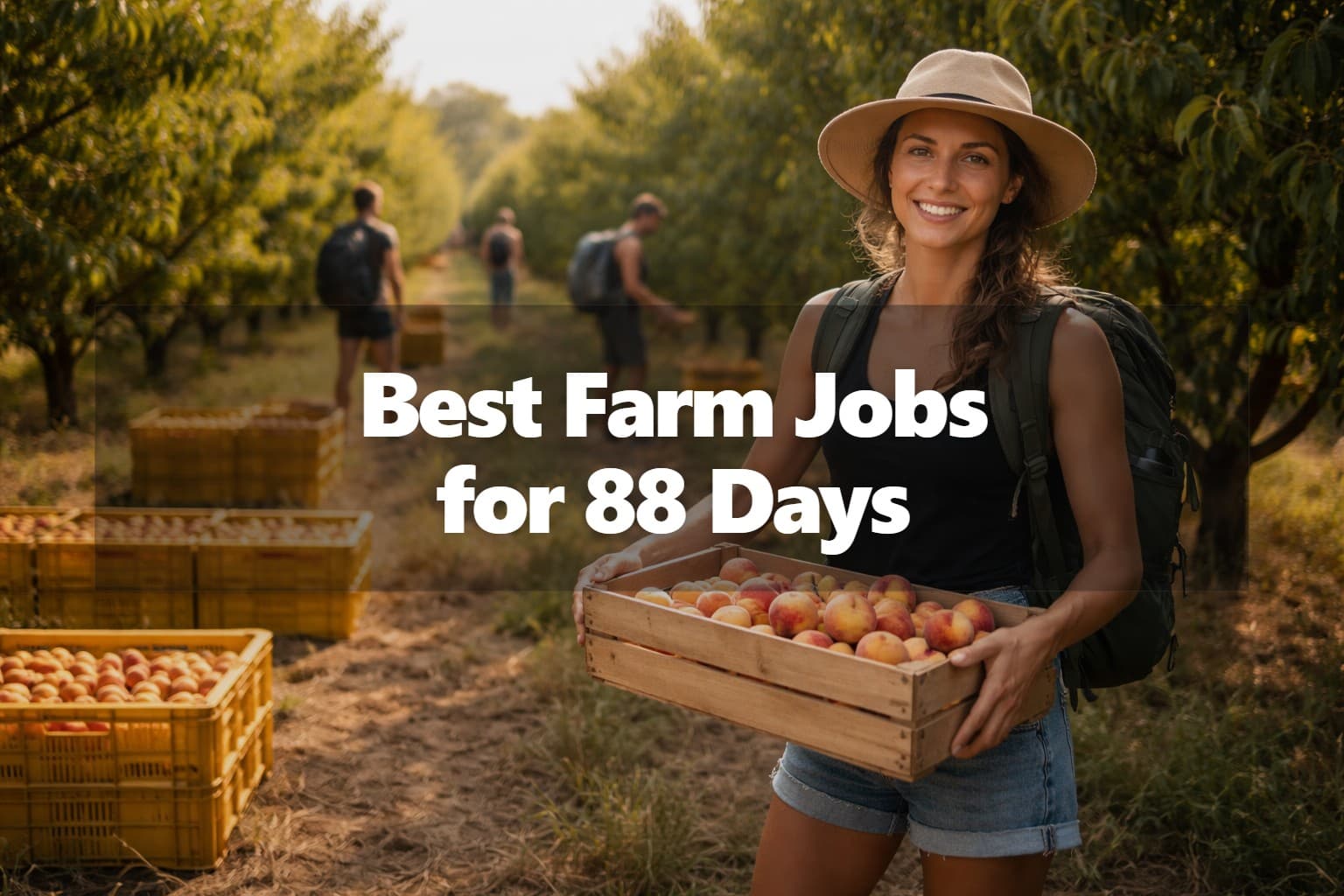
Best Farm Jobs for 88 Days in Australia: Which Ones Are Actually Worth It?
Compare the best farm jobs for 88 days in Australia by pay, stability, learning curve, and second-visa practicality.
Best Farm Jobs for 88 Days in Australia: Which Ones Are Actually Worth It?
If your goal is just to "get the 88 days done," almost any qualifying farm job can look good from a distance. But if your goal is to finish your days without wrecking your body, your savings, or your motivation, then some farm jobs are clearly better than others.
The best farm jobs for 88 days usually combine three things:
- reliable records
- decent income
- conditions that are hard, but not chaotic
This guide is for backpackers trying to choose better from the start. If you need the rule side first, read What Counts as 88 Days in Australia for a Second Visa?. If you want the full paid breakdown of farm-work economics, rate traps, and site selection, go deeper with Farm Work Deep Dive.
TL;DR
- The "best" farm job is not always the one with the highest advertised rate.
- Packing and structured shed work often feel safer and cleaner than chaotic picking jobs.
- Piece-rate jobs can pay well in strong conditions, but they can also crush beginners.
- Good employers with clean paperwork matter almost as much as the crop itself.
What Makes a Farm Job Good for 88 Days?
Backpackers often judge jobs too late. They only realise the site is weak after they have already moved, paid bond, and burned two weeks waiting for volume.
Use these four criteria earlier:
1. Can you actually accumulate days consistently?
The best 88-day job is one that lets you keep moving toward the target without constant dead time.
2. Is the pay structure understandable?
If you cannot explain how you are paid after day two, the site is already suspicious.
3. Are the records clean?
Payouts, dates, and employer details should be boringly clear.
4. Can you survive the work physically and mentally?
The highest-paying option is still a bad option if it breaks you by week three.
The Strongest Farm Job Types for Most Backpackers
Packing shed work
Packing is one of the better entry points for many people because it is usually more structured than field picking.
Good points:
- more predictable environment
- easier learning curve
- often clearer supervision
- easier to sustain for beginners
Tradeoff:
- not always the top pay
- repetitive
- can still be physically tiring
Pruning and maintenance work
Pruning can be a strong option if the employer is organised and the pace is realistic. It tends to reward rhythm more than raw speed.
Good points:
- less chaotic than some harvest peaks
- often easier to document cleanly
- more stable than "rush season" jobs
Tradeoff:
- can be slower money early on
- technique matters
Harvest picking in strong conditions
Picking is what most people imagine first. It can be good, but it is the most over-romanticised category.
Good points:
- can pay well when fruit quality and volume are strong
- easy to find in many backpacker circuits
Tradeoff:
- weather risk
- crop variability
- piece-rate traps
- beginners often underperform at first
Mixed farm roles on better-managed sites
Some of the best experiences happen on sites where you rotate between tasks instead of doing one miserable thing forever.
Good points:
- more stable hours
- broader exposure
- less mental fatigue
Tradeoff:
- depends heavily on employer quality
The Jobs That Look Better Online Than They Feel in Real Life
Pure piece-rate picking with weak training
If the fruit is hard to pick, the bins are spread badly, and nobody teaches you, piece-rate jobs can turn into fake high-income dreams very fast.
Sites with heavy accommodation dependency
If the employer also controls the transport, housing, roster, and social pressure, it gets harder to leave when things go bad.
Jobs with vague daily availability
If every answer sounds like "it depends on the crop," ask harder questions. Some variation is normal. Zero predictability is not.
How to Judge a Job Before You Move
Ask these questions:
- Is the pay hourly, piece-rate, or mixed?
- How many days did workers actually get last week?
- What is the typical start time and season length?
- Are payslips and records standard?
- Is accommodation optional or tied in?
- What usually happens when weather stops the work?
If the answers are evasive, trust the signal.
Best Jobs by Goal
If your goal is safest completion of 88 days
Look for structured sites, clear records, and steady routines.
If your goal is best money while doing 88 days
Look for stronger crop conditions, better-managed picking or higher-value agricultural work, but only if you can verify the site.
If your goal is easiest entry as a beginner
Packing and better-run shed work often beat aggressive field jobs.
If your goal is setting up for a bigger second-year income run
Use the 88 days period to learn where the higher-quality employers and regions actually are. Then connect that to Highest Paying Backpacker Jobs in Australia and the 88 Day Job Map.
A Better Way to Think About "Best"
The best farm job is usually the one that balances:
- good enough money
- cleaner admin
- less wasted time
- better odds of finishing the 88 days without chaos
That is more valuable than chasing the single most exciting pay claim in a Facebook group.
FAQ
Are picking jobs always the best for 88 days?
No. They are common, not automatically best.
Is packing easier than picking?
For many beginners, yes. It is often more structured and easier to sustain.
Should I choose the highest advertised rate?
Not without checking consistency, volume, and documentation. Advertised rates without context are weak signals.
Bottom Line
If you want to complete 88 days intelligently, choose jobs that are sustainable, documentable, and stable enough to keep momentum.
The job that gets talked about the most is not always the job that gets you through the season best.
Use the 88 Day Job Map to compare regions, then go deeper with Farm Work Deep Dive once you are narrowing real options.
Next Step
Compare Regional Farm Work
Use the map to compare where different farm-work clusters actually sit before you move.
Open-AU routes
Turn this guide into a map route
Fruit Picking
Fruit Picking jobs in Australia: compare 88 days fit, map clusters, pay, accommodation, guides, location analysis, and Australian English practice in one Open-AU route.
Open routeProduce
Produce jobs in Australia: compare 88 days fit, map clusters, pay, accommodation, guides, location analysis, and Australian English practice in one Open-AU route.
Open routeWinery
Winery jobs in Australia: compare 88 days fit, map clusters, pay, accommodation, guides, location analysis, and Australian English practice in one Open-AU route.
Open routeCotton
Cotton jobs in Australia: compare 88 days fit, map clusters, pay, accommodation, guides, location analysis, and Australian English practice in one Open-AU route.
Open routeGrain
Grain jobs in Australia: compare 88 days fit, map clusters, pay, accommodation, guides, location analysis, and Australian English practice in one Open-AU route.
Open routeMeat Processing
Meat Processing jobs in Australia: compare 88 days fit, map clusters, pay, accommodation, guides, location analysis, and Australian English practice in one Open-AU route.
Open routeRead Next
Farm Work Deep Dive: Picking, Packing & Pay (2026)
Inside guide to Australian farm and agricultural work—how piece-rate vs hourly pay really works, how to read picking conditions, what regional work counts toward your second visa, and which farms are worth your time.
Open articleWhat Counts as 88 Days in Australia for a Second Visa?
A practical guide to what counts toward 88 days for an Australian second Working Holiday visa, how days are calculated, and the mistakes that get backpackers rejected.
Open article